
The Future of the Hardware Industry: Trends, Innovations, and Opportunities
We tend to get excited about software. Apps, algorithms, AI models — that’s where most of the headlines go. But none of it works without the physical stuff underneath. The chips, the sensors, the circuit boards, the devices you hold in your hand or wear on your wrist or that hum quietly in a data center somewhere keeping the internet alive. Hardware is the foundation everything else is built on — and right now, it’s going through one of the most interesting periods in its history.
The chip is the story
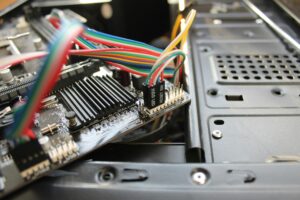
If you want to understand where hardware is heading, start with semiconductors. The race to build faster, smaller, more efficient chips has never been more intense — or more consequential. We’re talking about transistors measured in nanometers, packed onto silicon wafers with a precision that borders on the absurd. The move to 3nm chips and beyond isn’t just an engineering flex. It means more processing power in less space, using less energy. That matters enormously for everything from your phone’s battery life to the cost of running a data center.
And it’s not just about raw speed anymore. The real shift is toward specialized chips — processors designed not to do everything, but to do one thing exceptionally well. GPUs for graphics and AI. TPUs for machine learning workloads. Neuromorphic chips that actually mimic the way the human brain processes information. The era of the one-chip-fits-all processor is quietly giving way to something much more interesting.
Intelligence at the edge
For years, the assumption was that smart devices needed to talk to the cloud to do anything truly impressive. Send the data up, wait for the answer to come back down. That model is changing fast.

Edge computing — processing data locally, on the device itself — is becoming increasingly viable as chips get more powerful and efficient. Your phone making real-time decisions without pinging a server. A factory sensor catching an anomaly the instant it happens, not after a round trip to a cloud platform. This isn’t just about speed, though that matters. It’s about privacy, reliability, and the ability to function even when the connection drops. As AI chips get embedded into more and more devices, intelligence stops being something you access remotely and starts being something that lives with you.
A world of connected things
There are already more connected devices on earth than there are people. Thermostats, traffic sensors, medical monitors, industrial machines, agricultural equipment — the Internet of Things has moved well beyond the smart home gadget phase into something with real industrial weight.
What this means for hardware manufacturers is a relentless pressure to build devices that are smaller, tougher, cheaper, and longer-lasting than before. A sensor buried in a bridge or deployed in a remote field can’t be plugged into a wall every night. It needs to run for years on a tiny battery, survive harsh conditions, and keep transmitting data reliably. That’s a genuinely hard engineering problem — and solving it is unlocking entire new categories of application, from smart cities to autonomous vehicles to precision agriculture.

The sustainability problem nobody can ignore
Here’s an uncomfortable truth about the hardware industry: it produces an extraordinary amount of waste. Old phones, discarded laptops, obsolete components — electronic waste is one of the fastest-growing waste streams in the world, and a lot of it ends up in places it shouldn’t.
The industry knows this, and to its credit, it’s starting to take it seriously. Manufacturers are experimenting with recyclable materials, designing products that can be repaired rather than replaced, and rethinking the whole lifecycle of a device from the start. Modular design — where you can swap out a battery or upgrade a specific component without buying an entirely new device — is gaining traction as both an environmental and economic argument. A laptop you can actually repair is a laptop that doesn’t end up in a landfill after three years.
This isn’t just corporate responsibility talk anymore. Regulations are tightening, consumers are paying attention, and the companies that figure out how to build sustainably without sacrificing performance will have a real advantage.
Quantum computing — still early, but real
Quantum computing sits in that strange space between genuine scientific breakthrough and overhyped buzzword, depending on who you ask. The honest answer is: it’s both. The theoretical potential is staggering — solving problems in minutes that would take classical computers millions of years. Drug discovery, financial modeling, logistics optimization, cryptography — the applications are enormous.
But the hardware required to make quantum computing work is extraordinarily difficult to build and even harder to operate. Quantum processors need to run at temperatures colder than deep space. They’re fragile, error-prone, and nowhere near ready for mainstream deployment. Progress is real, though. Each year brings better processors, better error correction, more stable systems. It’s not a technology for next year — but writing it off as a distant fantasy would be a mistake.
Wearing the future
Smartwatches were just the beginning. The hardware sitting on or around your body is getting more sophisticated by the year — and more useful. Augmented reality glasses that overlay information onto the physical world. Health monitors that track not just your heart rate but your stress levels, your blood oxygen, eventually your blood glucose without a needle. Flexible displays that can wrap around surfaces or fold into forms that didn’t exist five years ago.
What’s making all of this possible isn’t any single breakthrough — it’s a combination of better batteries, lighter materials, more efficient chips, and improved sensors all advancing at the same time. The form factors that seemed like science fiction a decade ago are becoming engineering problems, not impossibility problems.
5G and what comes after
Faster wireless connectivity changes what hardware can do. Not in an abstract way — in a very concrete, what-becomes-possible way. Remote surgery guided by a specialist thousands of miles away requires a connection with essentially zero lag. Truly autonomous vehicles need to communicate with each other and their environment in real time. Immersive augmented reality experiences can’t afford the hiccup of a slow connection.
5G is making some of this viable. What comes after 5G will make more of it routine. Hardware designed for this era needs to handle data volumes and speeds that would have seemed unrealistic not long ago — while still being efficient, durable, and affordable enough to actually deploy at scale.
The challenges that don’t get enough attention
None of this is smooth sailing. The last few years have made brutally clear how fragile global hardware supply chains can be. A shortage of a single type of chip rippled through the auto industry, consumer electronics, and medical device manufacturing all at once. Geopolitical tensions over semiconductor manufacturing — who controls the most advanced fabrication plants, and where they’re located — have become a matter of national security for multiple governments.
Cybersecurity in hardware is also a growing concern that tends to get overshadowed by software security discussions. A vulnerability baked into a chip or a firmware stack can be far harder to patch than a software bug — and the consequences of getting it wrong in critical infrastructure are severe.