
If you showed someone from 1995 what gaming looks like today, they wouldn’t believe you. Not just the graphics — though those alone would be enough — but the scale of it. Hundreds of millions of people playing together across continents. Professional gamers filling stadiums. Virtual worlds where people spend real money on digital real estate. Games that tell stories as emotionally complex as anything in cinema or literature.
Gaming grew up. And it’s not done yet.
The headset problem — and why it’s finally getting solved

Virtual reality has been “the next big thing” for so long that people started rolling their eyes at the phrase. And honestly, fair enough. The early headsets were expensive, uncomfortable, nauseating after twenty minutes, and didn’t have enough good games to justify the hassle. For years, VR felt like a technology looking for a reason to exist.
Something has shifted. The hardware has gotten genuinely better — lighter, sharper, more comfortable, less likely to make you feel like you’re on a boat in rough weather. The experiences have gotten more compelling. And the price has come down enough that it’s no longer a purchase that requires a serious conversation with yourself about financial priorities.
We’re not at mass adoption yet. But for the first time, VR feels like it’s moving toward it rather than perpetually promising to. When the hardware clears one more generation of improvement and the library of great experiences reaches critical mass, the moment when people look back and say “that’s when VR actually happened” might be closer than the skeptics think.
Augmented reality — overlaying digital information onto the real world rather than replacing it — is taking a different path. Less about dedicated gaming hardware, more about becoming a layer that sits on top of everyday life. The gaming applications are interesting, but the bigger story might be what happens when AR becomes as natural as looking at your phone.
You don’t need an expensive PC anymore
For most of gaming’s history, there was a hard relationship between money and quality. Want to play the best games? Buy the best hardware. A high-end gaming PC. The latest console. The equation was simple and it excluded a lot of people.
Cloud gaming is dismantling that equation. The processing happens on a server somewhere; you just receive the video feed and send back your inputs. The game runs on hardware you’ll never see, in a data center you’ll never visit, and what arrives on your screen is indistinguishable from running it locally — if your internet connection is fast and stable enough.
That last qualifier is still doing a lot of work. Cloud gaming is genuinely great in cities with reliable high-speed internet and noticeably worse everywhere else. Latency — the tiny delay between your input and the game’s response — matters enormously in fast-paced games, and when it’s even slightly off, the experience suffers. The technology works. The infrastructure to support it everywhere doesn’t exist yet.
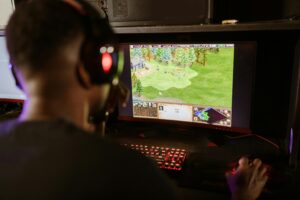
But the trajectory is clear. As connectivity improves globally, cloud gaming removes one of the biggest barriers to entry the industry has ever had. Playing a cutting-edge game on a mid-range phone or an old laptop — that changes who gets to participate in gaming in a meaningful way.
AI that actually makes games better
AI in gaming used to mean enemies that walked into walls and teammates with the tactical awareness of a houseplant. The bar was low, and it stayed low for a surprisingly long time.
What’s coming — and what’s already starting to appear — is genuinely different. NPCs that don’t just follow scripts but respond dynamically to what you do. Game worlds that remember your choices and evolve around them. Difficulty that adjusts not just to make things harder or easier, but to keep you in that specific zone where a game is challenging enough to be engaging without being frustrating enough to make you quit.
On the development side, AI tools are helping smaller teams build things that previously required massive studios. Generating environments, writing dialogue variations, playtesting systems automatically — AI is compressing what used to take years into something more manageable. That’s going to mean more games, from more diverse creators, with more varied visions of what a game can be.
The metaverse — let’s talk honestly about this one
There was a period when “metaverse” was the word that made tech executives sound visionary and made everyone else feel vaguely exhausted. The hype cycle peaked, the NFT market collapsed, and a lot of very expensive virtual real estate turned out to be worth considerably less than advertised.
But here’s the thing — the underlying idea isn’t wrong. Gaming platforms have been evolving into social spaces for years. Fortnite hosts concerts. Roblox is essentially a platform where kids build and share their own games. Minecraft has functioned as a creative and social space for over a decade. The “metaverse,” stripped of the buzzword baggage, is just what happens when a game becomes a place rather than just an activity.

The version that gets built won’t look like the renders from the hype period. It’ll be messier and more organic — spaces that grow because people genuinely want to spend time in them, not because investors decided they should exist. Some of those spaces will be gaming adjacent. Some will be something we don’t quite have a word for yet.
Esports became real when nobody was fully paying attention
There’s still a segment of the population that finds esports genuinely baffling — why would you watch someone else play a video game? — and there’s a much larger segment that has completely normalized it. Stadium events. Dedicated television coverage. Sponsorship deals from major brands. Players who are genuine celebrities in their sport with fan bases that cross national borders.
The infrastructure around competitive gaming is now substantial enough that it’s self-sustaining. Leagues, academies, coaching staffs, sports psychologists, team houses — the apparatus that surrounds traditional professional sports has largely been replicated. The prize pools at the top level are significant enough that elite players earn life-changing money. The career paths are real.
Where esports goes from here depends partly on whether it can solve a problem traditional sports don’t have: the games change. A sport played in 1990 is recognizable in 2025. A game from 2005 may be completely obsolete, its competitive scene replaced by whatever came next. Building sustained fandom around something that iterates as fast as games do is a different challenge than building it around football or basketball — and the esports industry is still figuring out the answers widespread enough to actively drive people away from games and communities they’d otherwise enjoy. Technical solutions help at the margins; the cultural work is harder and slower.