
We don’t think about oxygen. Not really. It’s just there — invisible, constant, taken completely for granted until the moment it isn’t. Ask anyone who’s watched a loved one struggle to breathe, or lived through a city where the air itself feels like something to endure rather than enjoy, and they’ll tell you: oxygen is everything.
The fact that we’ve figured out how to capture it, purify it, and put it to work is one of those quiet achievements of modern civilization that almost never gets its due. And right now, that achievement is getting more important — and more complicated — than ever before.
When Breathing Becomes a Medical Emergency

Start with the most obvious application: keeping sick people alive. Medical oxygen isn’t a luxury. For someone in the grip of a severe asthma attack, a COPD flare-up, or a pneumonia that’s filling their lungs with fluid, it’s the difference between life and death. Most of us don’t think about this until we’re in a hospital room watching a nurse adjust a flow meter. Then it becomes very real, very fast.
The COVID-19 pandemic made this visible at a global scale. Hospitals in some of the world’s most populated countries ran out of oxygen. People died not because no treatment existed, but because a basic, producible gas wasn’t available in the right place at the right time. That failure — logistical, infrastructural, political — exposed just how fragile the supply chain for something so fundamental can be.
The good news is that technology is catching up. Portable oxygen concentrators — devices that pull oxygen directly from the surrounding air and concentrate it — are getting smaller, cheaper, and more capable. Smart monitoring systems can track a patient’s oxygen levels continuously and adjust delivery in real time. The vision of a patient managing a chronic respiratory condition from home, with hospital-quality oxygen support, is already becoming reality in wealthier parts of the world. The challenge is making it reality everywhere.
The Air We Breathe in Cities
Step outside in Mumbai, Delhi, Beijing, or Cairo on a bad day and you understand immediately why clean air has become a public health crisis. The pollution isn’t just unpleasant — it’s shortening lives, quietly and at scale, in ways that don’t show up as dramatically as a single disaster but accumulate into something devastating.
This is pushing serious thinking about oxygen-enriched environments in urban spaces. Oxygen bars — where you pay to breathe concentrated oxygen through a nasal tube — have existed for years as a novelty, mostly in airports and tourist spots at altitude. But the underlying idea, of deliberately improving the air quality in specific environments, is being explored at a larger scale. Buildings designed to maintain higher oxygen levels. Public spaces with air quality systems built in. Transit infrastructure that doesn’t make commuters feel like they’re slowly poisoning themselves.
Whether these ideas scale from concept to city-wide implementation is still an open question. But the demand is real, and it’s only growing.
The Industrial Side of Oxygen
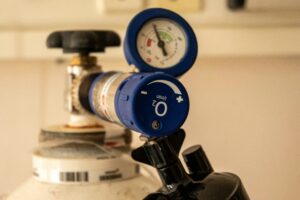
Pure oxygen has been a workhorse of heavy industry for a long time, quietly enabling processes most people never think about. Steel manufacturing. Chemical production. Wastewater treatment. These aren’t glamorous applications, but they’re essential — and they consume enormous quantities of oxygen.
What’s changing is the pressure on these industries to clean up their act. Oxygen enhanced combustion, where pure oxygen replaces or supplements regular air in industrial burning processes, allows fuel to burn more completely and efficiently. Less waste. Lower emissions. Better output. As the push toward greener industrial practices intensifies — driven by regulation, investor pressure, and genuine concern — the demand for high-purity oxygen in industry is expected to grow significantly.
Beyond Earth — and Below the Surface
Here’s where it gets genuinely exciting. Every serious plan for human presence on the Moon or Mars has oxygen at the center of it — not just for breathing, but for fuel. NASA’s MOXIE experiment on the Perseverance rover has already demonstrated that oxygen can be produced from the carbon dioxide in Mars’s thin atmosphere. That’s not a small thing. The ability to generate oxygen in situ — on the surface of another planet — changes the math of deep space exploration entirely. These feel like niche applications until you realize they represent the frontier of human ambition. And on every frontier, oxygen comes first.
The Wellness Industry — Useful, Overhyped, and Somewhere in Between

Walk through a high-end wellness center or browse certain corners of the internet and you’ll find oxygen being sold as a cure for everything — fatigue, mental fog, stress, aging. Canned oxygen for athletes. Oxygen facials. Hyperbaric chambers for recovery. The marketing is enthusiastic; the science is considerably more mixed.
Some of it is legitimate. Hyperbaric oxygen therapy has real, evidence-backed applications for wound healing and certain medical conditions. Supplemental oxygen at altitude genuinely helps. But a lot of the wellness oxygen industry is selling a feeling — and in some cases, selling it to people who don’t need it and won’t benefit from it.
Making Production Smarter and Cleaner
AI is beginning to touch oxygen systems in useful ways — monitoring patient needs in real time, predicting demand surges in hospitals, optimizing supply chains to reduce waste. Smart oxygen management in a large hospital is a genuinely complex logistics problem, and better data and algorithms can make a real difference in both outcomes and efficiency.
On the production side, the goal is oxygen that’s cheaper to make, less energy hungry to produce, and easier to distribute in places with limited infrastructure. Smaller, more efficient generation units that can operate in remote clinics. Solar powered concentrators that don’t depend on a stable electrical grid. These aren’t futuristic concepts — they’re in development and in some cases already deployed. Scaling them is the work.
The Element We Owe Everything To
There’s something almost philosophical about the fact that we’re now engineering, distributing, and optimizing the supply of an element that makes up a fifth of our atmosphere and has sustained life on this planet for billions of years. It speaks to how thoroughly human civilization has pushed against its natural limits — in medicine, in industry, in exploration — and how much work goes into maintaining the infrastructure of survival that most of us never see.