
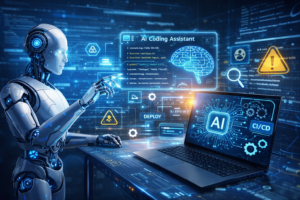
Artificial intelligence has evolved from a catchphrase to a potent force that is changing the development, testing, and upkeep of software. AI tools are transforming the whole software development lifecycle, from automated testing to code generation. However, what specific effects are AI tools having on the software sector? Let’s dissect it.
1. AI Coding Assistants for Quicker Development
Developers are writing code more quickly than ever thanks to AI-powered coding assistants like ChatGPT and GitHub Copilot.
These instruments:
-
Real-time code suggestions
-
Auto-completion features
-
Write boilerplate code.
-
Assist in debugging errors
This drastically cuts down on development time. These days, developers are more concerned with logic and architecture than with monotonous work.
Faster product delivery is the outcome.
2. Improved Error Detection and Debugging
Before deployment, AI tools can identify possible bugs by analyzing code patterns.
Advantages consist of:
-
Predictive identification of bugs
-
Automated recommendations for error correction
-
Decreased production problems
-
Higher-quality code
Overall software reliability is increased as a result.
3. Automated QA and Testing
Testing tools powered by AI can:
-
Automatically create test cases
-
Carry out regression testing.
-
Find UI inconsistencies
-
Examine performance snags.
AI dramatically lowers manual labor and improves accuracy for businesses that use load and regression testing, such as many IT teams nowadays.
4. Improved Deployment & DevOps
AI helps in:
-
Forecasting server malfunctions
-
Keeping an eye on performance problems
-
Reducing the cost of infrastructure
-
CI/CD pipeline automation
As a result, DevOps is no longer reactive but rather more intelligent and proactive.
5. Customized User Experiences
AI is now used in modern software to:
-
Make content recommendations
-
Customize dashboards
-
Enhance search outcomes
-
Examine user conduct
Instead of users adapting to software, AI allows software to adapt to users.
6. Effect on Jobs in Software
AI is altering the roles of developers, not replacing them.
Developers now require:
-
Excellent ability to solve problems
-
knowledge of AI tools
-
Knowledge of system design
-
The capacity for critical thought
While routine coding is declining, there is a growing need for qualified engineers.
7. Hazards and Difficulties
AI has many benefits, but it also raises some issues.
-
Risks to code security
-
Over-reliance on artificial intelligence
-
Problems with intellectual property
-
Diminished proficiency in deep coding
Businesses must use AI sensibly while maintaining the importance of human review.
AI’s Prospects in Software
By 2030, AI is probably going to:
-
Create complete applications automatically
-
Real-time performance optimization
-
Prior to interaction, anticipate the needs of the user.
-
Cut development expenses significantly
AI is evolving into a development partner rather than merely a tool.
Concluding Remarks
Every aspect of the software industry is changing as a result of AI tools: development, testing, deployment, and user experience.
The technology of the future will be driven by the businesses and developers who adjust first.
Learning how to use AI effectively is a better course of action than being afraid of it.